
Start with the exact transmitter, not a generic microphone category
Wireless microphones differ in supported battery types, compartment design, runtime calculation and charging options. A recommendation that works for one transmitter family may be wrong for another. Review the exact manufacturer guide and firmware before choosing a cell. Shure's SLX-D documentation states that the installed AA battery type should be selected for accurate runtime display. ULX-D documentation likewise instructs users to set the appropriate AA battery type for accurate monitoring. Those instructions demonstrate a broader point: the meter is part of the transmitter system and its assumptions matter. They do not prove compatibility with a particular third-party cell.
Record the transmitter model, revision, RF power, display settings, expected continuous operating time and compartment dimensions. Include any official restriction on alkaline, Ni-MH, lithium primary, regulated rechargeable lithium or proprietary packs. If the system supports a rechargeable pack with direct telemetry, compare that operational benefit as well as energy. The buyer's decision may be driven by the confidence of the runtime display, contact fit or charging ecosystem rather than the largest number printed on an AA label.
| Input | Evidence | Decision affected |
|---|---|---|
| Exact model and firmware | Manufacturer guide and device menu | Supported types and meter behaviour |
| RF and audio settings | Production show configuration | Runtime validation load |
| Compartment | Drawing and fit inspection | Contact stability and removal |
| Show duration | Call sheet plus contingency | Minimum usable runtime |
| Battery display | Type setting and warning logic | Operator confidence and change point |
Define a runtime policy before measuring runtime
A venue rarely needs a cell to run until the transmitter shuts down. It needs every channel to complete a show, rehearsal or conference block with a defined margin. Set the operational endpoint first: for example, cells are changed at a fixed break, when the display reaches an agreed threshold or after a maximum number of sessions. Then test whether the candidate supports that policy under the actual transmitter settings. A single maximum-runtime figure can be less useful than consistent completion of the planned block across all channels and sample sets.
Use production RF power, display brightness, audio mode and any network or encryption features that affect consumption. Start cells from a defined condition and record meter readings at scheduled intervals. Test at relevant temperatures, especially when equipment moves between storage, transport and a warm venue. Do not infer a public runtime from one transmitter and one cell pair. The release decision should include sample count, variation and a reserve rule. When operations change transmitter settings or show length, revisit the policy rather than assuming the original margin remains.
- Choose the operational change point before the test
- Use production RF and display settings
- Record meter state as well as elapsed time
- Retain a reserve set for exceptions and delayed programs
- Separate an internal acceptance result from a public runtime claim
Battery-meter accuracy can matter more than remaining energy
A transmitter can estimate remaining operation only through information available to it. Depending on the system, that may include a selected battery profile, terminal voltage, load response or data from a proprietary pack. When the selected profile does not match the installed cell, the display can become a poor guide even if the transmitter continues to operate. That is why official instructions to choose the correct AA type are operational requirements, not menu decoration. Include the setting in the show checklist and verify that technicians can see and change it correctly.
Evaluate the full warning sequence. Record when the display changes, whether the indication is stable during RF transmission and how much of the approved show block remains. A regulated cell may present a different voltage shape from alkaline or Ni-MH. A generic statement that it holds 1.5 V does not establish that the transmitter will predict its shutdown correctly. If the meter cannot provide a reliable window, a conservative fixed replacement schedule may be necessary. That operational cost belongs in the battery comparison together with price, charging time and waste.
Cell fit and set control are part of reliability
AA is a dimensional format, but real compartments, doors, springs and removal features still need inspection with the exact candidate. A cell that is difficult to remove can slow changeover. A marginal contact can cause an intermittent reset that looks like an exhausted battery. Inspect polarity protection, terminal contact, door closure and movement during handling. Repeat the check across sample cells and transmitters, not only the best-fitting pair. If sleeves, adapters or modifications are needed, they become part of the approved configuration and require their own risk review.
Manage removable cells as sets. Mark or digitally identify pairs, keep age and use history together, and remove a set when one member shows damage or abnormal behaviour. Do not combine a newly charged cell with a partly used cell in a series pair. Establish inspection criteria for wraps, terminals, leakage, swelling or contamination according to the approved chemistry and manufacturer guidance. A clear quarantine route prevents a questionable cell from returning to the ready case during a rushed event reset.
- Verify insertion, contact and removal in every transmitter model
- Keep paired cells together through use and charging
- Quarantine damaged or abnormal cells
- Prevent mixed state-of-charge sets
- Record set identity when diagnosing early changes
Size charger capacity from the turnaround window
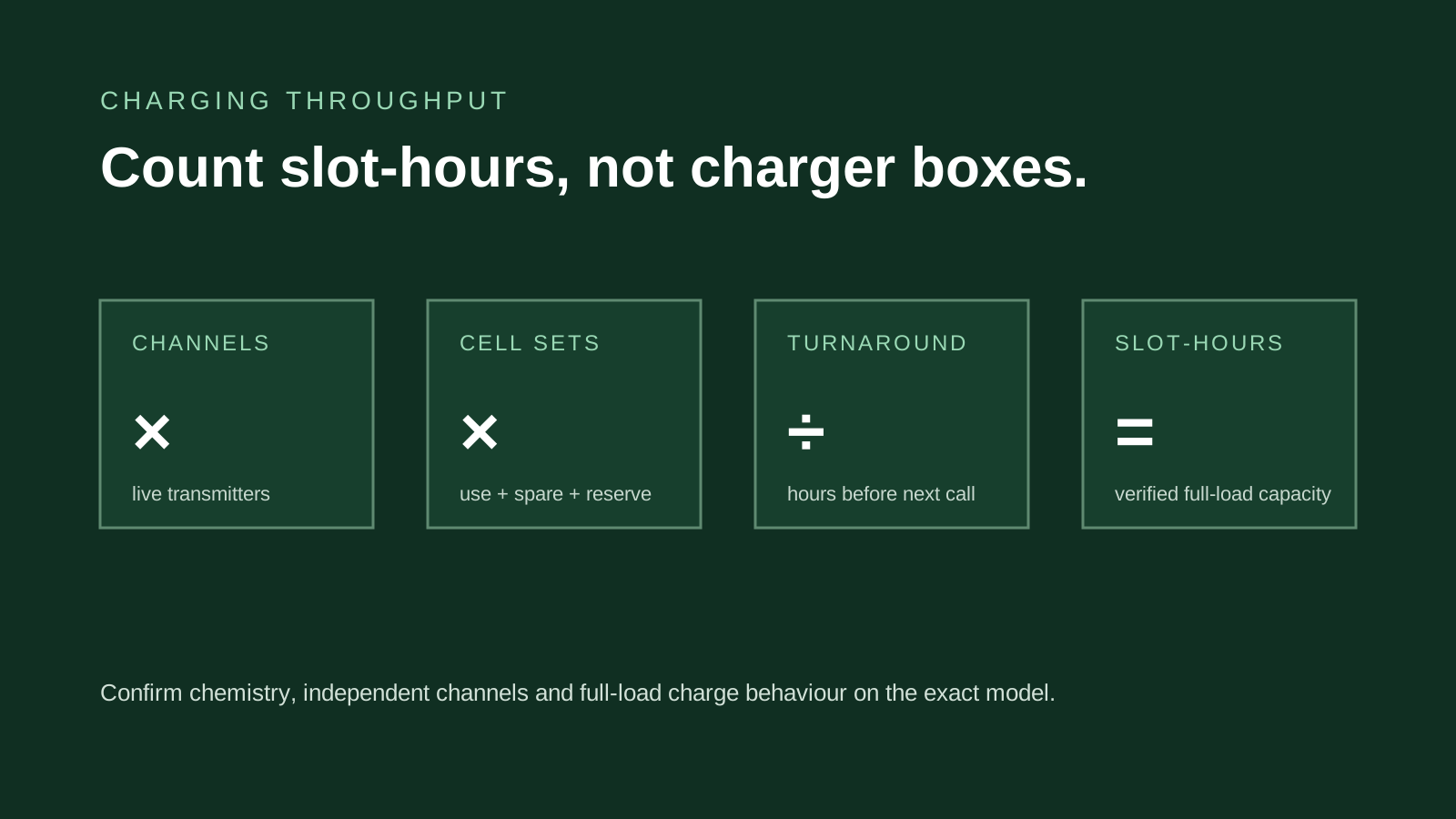
Count cells in rotation, not microphones alone. A transmitter using two AA cells needs an operating set. The fleet may also need a second set ready for changeover and a reserve pool. Multiply channels by cells per channel and planned sets, then compare that total with the slot-hours available between use and the next call. A charger with many slots does not automatically recover the fleet in time; per-slot current, simultaneous-slot behaviour, charge termination and the condition of incoming cells all affect turnaround.
Confirm the exact charger specification. Chemistry support, independent or paired channels, input power and current distribution can vary by model. Do not infer lithium support from a charger designed for Ni-MH and Ni-Cd. Decide whether technicians need individual status, capacity checks or simple charge completion. Plan electrical outlets, cable management, ventilation and case layout. For larger fleets, separating charging, ready and quarantine zones reduces the risk of mixing states. The correct number of chargers is the number that returns the required sets to a verified ready state with margin, not the smallest number that can physically hold them.
| Variable | Question | Planning use |
|---|---|---|
| Channels | How many transmitters can be live? | Defines operating cell count |
| Cells per channel | One, two or a proprietary pack? | Converts channels to cells |
| Ready sets | How many complete changes are required? | Adds changeover and reserve inventory |
| Turnaround | Hours from return to next call? | Sets available charging time |
| Verified slot time | How does the exact charger behave when full? | Determines charger quantity with margin |
Make battery state visible throughout the show day
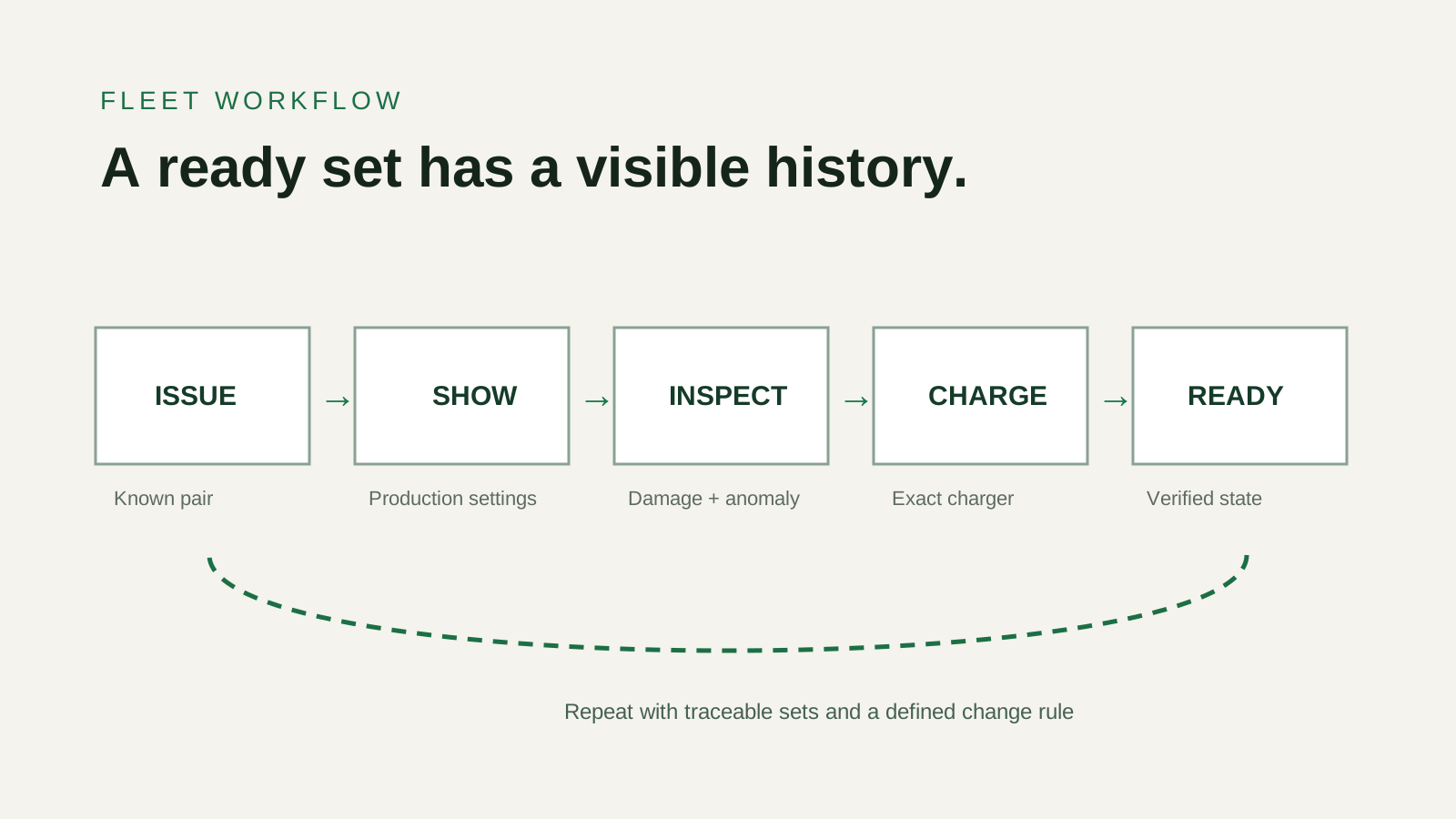
Define named states such as ready, issued, used, charging, complete and quarantine. Use trays, cases or labels that make the state obvious without relying on memory. At issue, record the set and transmitter when the production requires traceability. At return, inspect cells before charging and note any unexpectedly low meter reading or interruption. Move charged cells to ready storage only after the charger's completion indication and any required check. This simple flow prevents partly used cells from being mistaken for ready cells and gives technicians evidence when one channel behaves differently.
The handoff matters between teams and shifts. A charging rack that looks full does not tell the next operator when cells arrived, whether charging finished or whether a fault was observed. Use a written or digital log sized to the operation. Keep the method light enough that staff will follow it under event pressure. Review exceptions after the show: repeated early changes on one transmitter may point to settings or contacts, while issues following one set may point to the cells. The workflow turns scattered anecdotes into diagnostic information.
- Use visible states for ready, used, charging and quarantine
- Log abnormal meter behaviour and interruptions
- Verify completion before returning a set to ready inventory
- Review whether issues follow the transmitter or the cell set
Compare chemistry through the fleet's operating rules
Alkaline can offer a simple issue-and-dispose workflow, but recurring events create purchase, storage and waste considerations. Ni-MH is widely used in managed rechargeable fleets when transmitters support it; success depends on charger throughput, set control and an approved change point. Regulated rechargeable lithium AA cells provide a different voltage and charging model and require exact-transmitter validation, correct transport documentation and a clear end-of-discharge policy. Proprietary rechargeable packs may offer better system telemetry or integrated charging at a higher ecosystem cost. None is automatically best for every venue.
Score candidates against the agreed show block, meter confidence, fit, charging turnaround, reserve policy, staff workload, replacement criteria, transport and total program cost. Keep measured evidence separate by exact model. A supplier's general application icon or a venue's success with another transmitter is a lead for testing, not proof. If the transmitter manual or support policy excludes a cell type, resolve that before field use. The strongest recommendation is the one whose operating rule can be taught, repeated and audited by the venue.
| Criterion | Acceptance question | Common evidence |
|---|---|---|
| Support | Does the exact transmitter permit the type? | Current official manual |
| Runtime policy | Does every set complete the show block with margin? | Controlled transmitter test |
| Meter | Is the display useful at the approved change point? | Timed meter and warning record |
| Throughput | Can all required sets return to ready in time? | Full-load charger timing |
| Operations | Can staff identify state and exceptions? | Documented fleet workflow |
The microphone-fleet sourcing brief we would ask for
Send the exact transmitter models and firmware, supported battery types from the manuals, cells per transmitter, RF power and production settings, show and rehearsal duration, approved change point, number of simultaneous channels, number of ready sets, turnaround window, existing charger models, required indicator or test features, operating and transport temperatures, target markets, shipment route and annual cell volume. Include any field issue you are trying to solve, such as an inaccurate meter, slow charging, difficult removal or inconsistent completion of a session.
PUJIMAX can compare that brief with current published cell and charger specifications and identify which model-level evidence is available. A sample plan should then test the exact transmitter, setting, cell, charger and workflow. The result may support a shortlist or show that a current model is unsuitable. That negative result is useful: it prevents a fleet from standardizing on a battery program that operators cannot monitor or recover between events. Final runtime and compatibility remain outcomes of the buyer's validated configuration, not promises created by this article.
- Exact transmitter and current manual
- Production RF/settings and show block
- Channels, cells per channel and ready sets
- Turnaround window and full-load charger behaviour
- Meter acceptance and change rule
- Market, transport and model-level document needs
Sources and evidence checked
- SLX-D digital wireless system guideShure · checked 2026-08-28
- ULX-D dual and quad receiver guideShure · checked 2026-08-28
- Nickel-metal hydride application and design criteriaVARTA Microbattery · checked 2026-08-28
- Nickel-metal hydride battery handbookPanasonic Industry Europe · checked 2026-08-28
Frequently asked questions
Why does the battery-type setting matter on some wireless transmitters?
The transmitter can use the selected profile when estimating remaining operation. Follow the exact manufacturer's instructions and verify the display with the installed cell type.
How many charger slots does a microphone fleet need?
Calculate cells in rotation and the time available before the next use. Confirm charge time and current with every required slot occupied on the exact charger.
Can one runtime test support every transmitter setting?
No. Runtime depends on the exact transmitter, settings, condition and acceptance endpoint. Freeze those inputs and repeat representative samples.